7 Coffee Table Styling Approaches Compared: Which One Suits Your Living Room?
By Niklas Ekstrand, Furniture & Maker Editor · November 17, 2026
Why styling method matters more than any single object
Most advice about coffee tables focuses on individual items: a candle here, a stack of books there. But the bigger decision happens earlier, when you choose an overall approach. A table styled around a single tray behaves differently day to day than one built around a sculptural centerpiece or a rotating "zone" system. If you're still working out the fundamentals of balance, scale, and negative space, our beginner's guide to building a balanced vignette covers that foundation. This article is for the next step: comparing the practical systems people actually use, so you can pick one that fits your furniture, your habits, and how much maintenance you're willing to do.
How to use this comparison
Each approach below is evaluated on four practical criteria: upkeep required, cost to set up, how well it survives daily use (drinks, remotes, kids), and the kind of room it suits best. None of these is objectively "correct" — the right one depends on whether your coffee table is a functional landing pad or a largely decorative surface.
1. The Tray Anchor Method
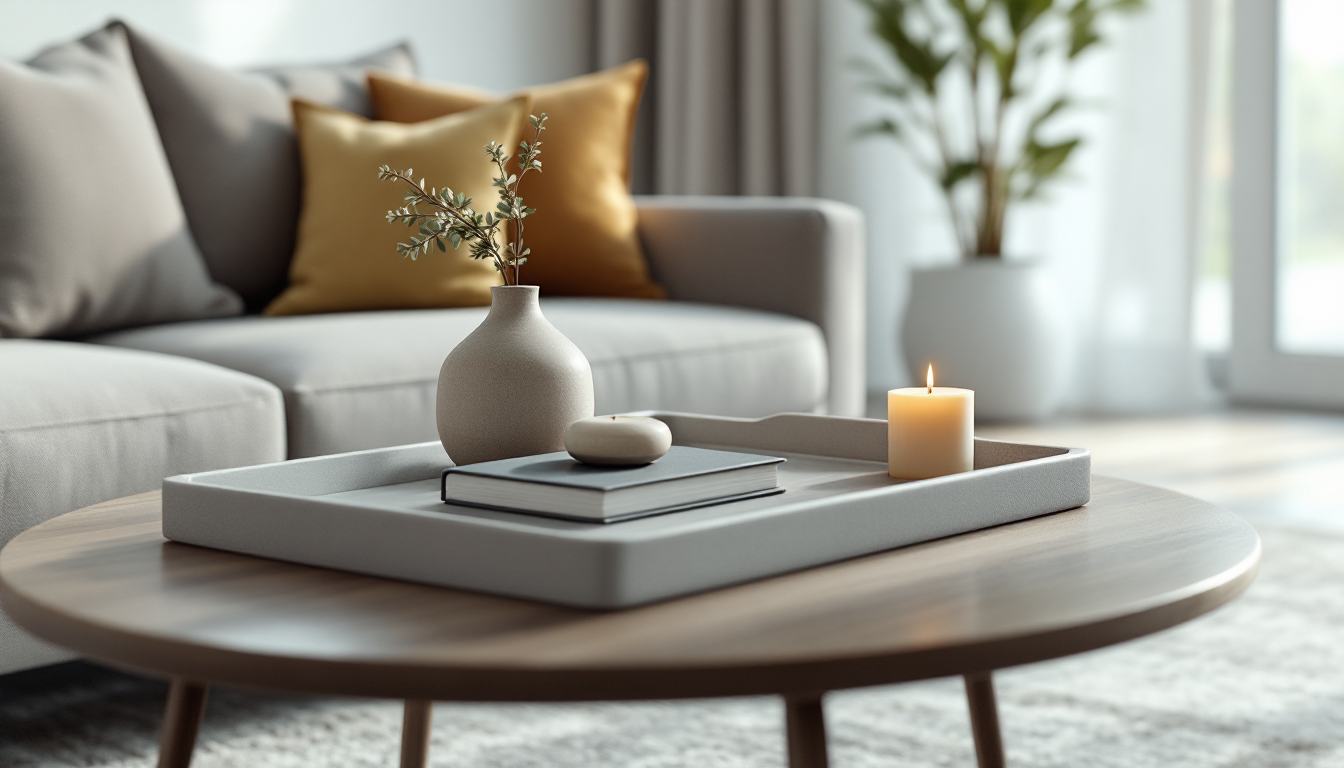
A single large tray corrals three to five objects — candle, small dish, one stack of books — into one visual unit. It's the fastest way to make scattered items look intentional.
- Upkeep: Low. Move the tray, clean under it, put it back.
- Cost: Low to moderate; one good tray does most of the work.
- Durability: High — the tray itself absorbs rings and spills.
- Best for: Busy households and rental apartments where quick resets matter.
2. The Rule-of-Three Cluster
Three objects of varying height (tall, medium, low) grouped without a tray. This is the classic interior-design default because it photographs well and reads as "styled" without extra hardware.
- Upkeep: Moderate — objects can drift out of position.
- Cost: Moderate; you're buying for height variation, not just taste.
- Durability: Medium — no barrier between objects and the tabletop.
- Best for: Living rooms where the table is more display surface than work surface.
3. The Book Stack Foundation
Two or three oversized books stacked flat, topped with one small object (a bud vase, a small bowl, a paperweight). Height does the visual work instead of variety of objects.
- Upkeep: Low once arranged.
- Cost: Low if you already own books; otherwise decorative books add up.
- Durability: Medium — book covers show wear from mugs and condensation.
- Best for: Readers who want the stack to look curated rather than leftover from last night's coffee table clutter.
4. The Sculptural Centerpiece
One large, deliberate object — a ceramic form, a wood bowl, a piece of art glass — sits alone or nearly alone on the table. This works especially well on a warm minimalist table where restraint is the point.
- Upkeep: Very low — nothing to rearrange.
- Cost: Can be high depending on the piece, but you're buying once.
- Durability: High, assuming the object itself is sturdy.
- Best for: Tables that rarely hold drinks or remotes — a secondary table or an entry console doing coffee-table duty.
5. The Functional-First Layout
Built around what the table is actually used for: coasters within reach, a remote caddy, a small bowl for odds and ends. Styling is secondary to usability.
- Upkeep: Low — the layout is designed to tolerate daily use.
- Cost: Low.
- Durability: Very high.
- Best for: Households with kids, pets, or anyone who wants the table to work harder than it poses for photos.
6. The Seasonal Rotation System
A set of two or three pre-planned "looks" (greenery and candles in winter, a single bloom and lighter tones in summer) that you swap on a schedule rather than improvising each time.
- Upkeep: Moderate, but concentrated into a few swap days a year rather than constant tweaking.
- Cost: Moderate to high — you're maintaining multiple small collections.
- Durability: Varies by season's materials.
- Best for: People who enjoy refreshing a room and don't mind storing off-season pieces.
7. The Collector's Stack
An intentionally eclectic mix — stones, small art, a vintage find, a plant — layered with less symmetry and more personality. It rewards a good eye for editing, since the line between "curated" and "cluttered" is thin.
- Upkeep: High — requires regular editing to avoid tipping into clutter.
- Cost: Variable; often built slowly over time rather than bought as a set.
- Durability: Medium, depends on materials chosen.
- Best for: Design-confident homeowners who want the table to tell a story, not just fill space.
Matching the approach to your table and room
The table itself should inform the decision as much as taste does. A glass-top table hides tray edges and shows every fingerprint, which favors the Tray Anchor or Functional-First methods. A live-edge wood table has enough visual interest on its own to carry a Sculptural Centerpiece without competing. If your coffee table sits inside an L-shaped living room layout where it's viewed from multiple angles, favor symmetry-friendly methods like the Rule-of-Three or Book Stack, since asymmetric collector-style arrangements can look unfinished from the "wrong" side.
If you're building or buying furniture to match a chosen styling approach — say, a lower profile table for a Sculptural Centerpiece, or a sturdier top for Functional-First use — it helps to visualize the piece in your actual room before committing. Tools like the room planning features on home3dplan.com let you test table dimensions and placement against your existing layout, so the styling decision and the furniture decision reinforce each other instead of being made separately.
Quick decision guide
- Want low effort, high polish: Tray Anchor or Functional-First.
- Want a design-magazine look: Rule-of-Three or Book Stack Foundation.
- Want bold simplicity: Sculptural Centerpiece.
- Want variety through the year: Seasonal Rotation.
- Want personality over polish: Collector's Stack.
Whichever method you choose, the goal is the same one covered in the fundamentals guide: leave enough negative space that the table still looks intentional, not crowded. Pick the system that matches how you actually live with the table, not just how it photographs on day one.